The Arachnid Dream: Oraxia's Weaving into Warframe's Isleweaver
Discover Warframe's stunning Isleweaver update featuring Oraxia, a mesmerizing spider-themed Warframe blending artistry, innovation, and mythic allure for an epic gaming experience.
In the shimmering expanse of Warframe's ever-evolving universe, the Isleweaver update unfurls like a silken thread, introducing Oraxia—a spider-themed Warframe that fans have long yearned for. As the digital dawn breaks in 2025, players find themselves drawn into a realm where artistry and mechanics intertwine, a testament to the developers' dedication. Oraxia emerges not just as a character, but as a living embodiment of patience and passion, her eight limbs dancing through the void with an eerie grace that whispers of ancient myths and modern marvels. 😊 The air crackles with anticipation, for this is more than an update; it's a poetic journey into the heart of creation, where every animation and design choice tells a story of struggle and triumph.
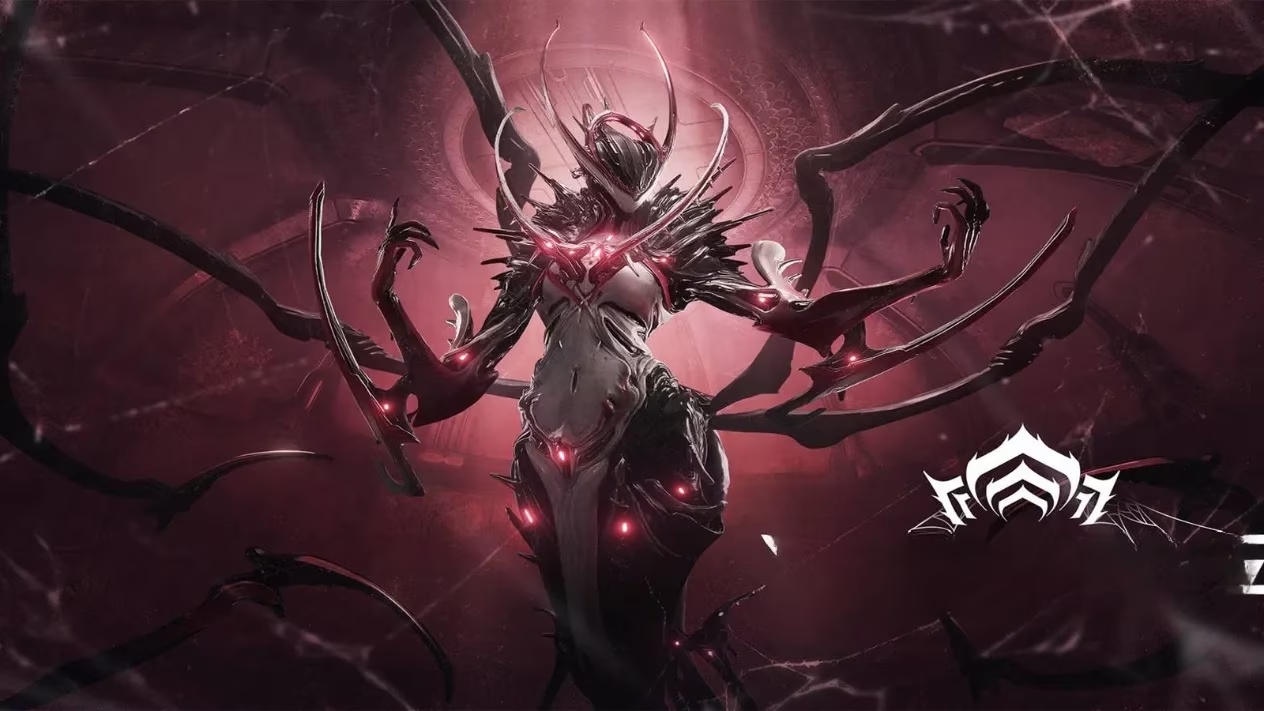
The conception of Oraxia began in the quiet depths of January 2023, a seed planted in the fertile soil of Warframe's narrative. Nikita Leshakov, the principal artist, recalls how the idea had lingered for years, longer than his tenure, only to bloom now when the story's tapestry had woven a perfect niche. 🕷️ It wasn't mere chance; it was destiny's hand guiding the team, ensuring Oraxia's arrival felt organic and essential. As a player, I can't help but marvel at this synchronicity—how the wait transformed into a gift, allowing the visuals to mature into something breathtaking. Leshakov's initial sketches, crude and unrefined, evolved through countless iterations, each stroke a battle against self-doubt. He admits that earlier designs were discarded, a humbling reminder that true art demands time. The chaos of sculpting without finalized concepts, where ideas flowed directly from mind to model, speaks volumes about the creative fire that fuels Warframe. This journey, fraught with false starts, ultimately birthed a Warframe that feels both alien and intimately familiar, a spider queen whose presence commands awe.
Animating Oraxia proved a Herculean task, as Jay Baker, the lead animator, vividly describes. Her multiple limbs—a first in Warframe's history—required ingenious solutions. The team divided her body into upper and lower channels using an animation mask, a delicate dance of technology and intuition. 🕸️ Yet, this wasn't enough; hip and spine orientations clashed, creating jarring offsets in aim poses. Personal feelings surge here—I recall my own moments of frustration in-game when animations glitch, but seeing how they crafted custom orientations to fix this fills me with admiration. It's a reminder that behind every seamless motion lies sweat and tears. The process wasn't just technical; it was an emotional waltz, where each tweak brought Oraxia closer to life.
Oraxia's abilities, especially her ultimate fourth power, became the centerpiece of this symphony. Initially conceived as a walls-only feature, it expanded to include ground mechanics, amplifying the scope and challenge. Baker confesses it was the most demanding animation, yet the result—a whirlwind of bladed legs slicing through enemies—justifies every extra hour. As a player, I can already envision the thrill of unleashing this in battle, the rush of power as her limbs become weapons of elegant destruction. 😍 The development timeline, though standard, faced unforeseen hiccups, pushing the team to their limits. But through it all, they persevered, delivering a kit that's both innovative and harmonious.
Collaboration between art and design teams was crucial, as Leshakov and Baker reveal. Ideas flowed in a vibrant back-and-forth: visuals inspired mechanics, and mechanics reshaped visuals. For instance, Oraxia's spider legs weren't always prominent; early designs had them wrapped around her ribcage, mere flavor elements. But a prototype convinced the team to embrace full functionality, leading to four legs around her tailbone instead of six along the spine—a compromise born of technical pragmatism. This synergy resonates deeply with me; it mirrors how players adapt and innovate in-game, turning limitations into strengths. The journey wasn't smooth, with scrapped concepts like articulating tonfa blades that later inspired abilities. Here's a glimpse of the key iterations and outcomes:
| Design Phase | Key Changes | Outcome |
|---|---|---|
| Early 2023 | Spider limbs as ribcage decor | Scrapped due to aesthetic dissatisfaction |
| Mid-2024 | Six legs along spine | Revised to four for gameplay feasibility |
| Final 2025 | Ground mechanics for ultimate | Implemented after prototype success |
Such iterations highlight the fluid dance of creation, where failure fuels progress.
Amidst the triumphs, there were losses—designs left on the cutting room floor. Leshakov speaks of an early concept from 2023 that felt unfinished and unworthy, a relic of his evolving artistry. Baker adds that the fourth ability's original vision of wall and ceiling walking had to be scaled back due to complexity, a decision made with player enjoyment in mind. 💔 As a fan, this stirs a bittersweet empathy; we crave the fantastical, but understand the realities of development. The timeline stretched, yet the outcome shines—a Warframe that stands as the 61st in a lineage defined by consistency and uniqueness. Leshakov draws from a decade-long library of references, while Baker ensures core movements remain familiar, with idles and abilities injecting individuality. It's a balance that feels almost magical, like watching a spider weave a web in the moonlight—each thread precise, yet part of a grander design.
In the end, Oraxia's arrival in Isleweaver is more than an update; it's a love letter to the community, a culmination of years of whispers and wishes. As players step into her exoskeleton, they embody not just a warrior, but a piece of the developers' souls. What does the future hold for Warframe as it continues to spin new tales into its vast, ever-expanding universe?